


Page 73 - 全球能源互联网资讯-第10期(12月)-英文
P. 73
GEIDCO Members                                                             NO.10    2020 / 12


            and less predictable power generation sites; and
            the need to significantly upgrade and expand grid
            capacity to accommodate the rapid growth in demand.
               In order to manage fluctuating electricity
            production and new consumption patterns, our
            energy system needs to become more flexible and
            new tools are required to deliver this. Innovative grid
            components using power electronics will provide
            the operational flexibility needed to enable grids to
            become more efficient. Sensors will provide the
            necessary information and digital solutions will
            process the huge amount of information in intelligent
            grid control centers. This will enable faster decision
            making in a much more dynamic environment than
            we have ever seen in the past.
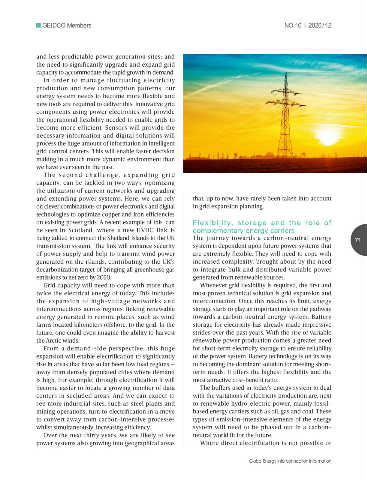
               The  second  challenge,  expanding  grid
            capacity, can be tackled in two ways: optimizing
            the utilization of current networks and upgrading
            and extending power systems. Here, we can rely   that, up to now, have rarely been taken into account
            on clever combinations of power electronics and digital   in grid expansion planning.
            technologies to optimize copper and iron efficiencies
            on existing power grids. A recent example of this  can   Flexibility, storage and the role of
            be seen in  Scotland,  where  a new HVDC  link  is   complementary energy carriers
            being added to connect the Shetland Islands to the UK   The journey towards a carbon-neutral energy   71
            transmission system.  The link will enhance security   system is dependent upon future power systems that
            of power supply and help to transmit wind power   are extremely flexible. They will need to cope with
            generated on the islands, contributing to the UK’s   increased complexity, brought about by the need
            decarbonization target of bringing all greenhouse gas   to integrate bulk and distributed variable power
            emissions to net zero by 2050.                   generated from renewable sources.
               Grid capacity will need to cope with more than   Whenever grid flexibility is required, the first and
            twice the electrical energy of today. This includes   most proven technical solution is grid expansion and
            the expansion of high-voltage networks and       interconnection. Once this reaches its limit, energy
            interconnections across regions, linking renewable   storage starts to play an important role on the pathway
            energy generated in remote places, such as wind   towards a carbon-neutral energy system. Battery
            farms located kilometers offshore, to the grid. In the   storage for electricity has already made impressive
            future, one could even imagine the ability to harvest   strides over the past years. With the rise of variable
            the Arctic winds.                                renewable power production comes a greater need
               From a demand-side perspective, this huge     for short-term electricity storage to ensure reliability
            expansion will enable electrification to significantly   of the power system. Battery technology is on its way
            rise in areas that have so far been low load regions –   to becoming the dominant solution for meeting short-
            away from densely populated cities where demand   term needs. It offers the highest flexibility and the
            is high. For example, through electrification it will   most attractive cost-benefit ratio.
            become easier to locate a growing number of data    The buffers used in today’s energy system to deal
            centers in secluded areas. And we can expect to   with the variations of electricity production are, next
            see more industrial sites, such as steel plants and   to renewable hydro-electric power, mainly fossil-
            mining operations, turn to electrification in a move   based energy carriers such as oil, gas and coal. These
            to convert away from carbon-intensive processes   types of emission-intensive elements of the energy
            whilst simultaneously, increasing efficiency.    system will need to be phased out in a carbon-
               Over the next thirty years, we are likely to see   neutral world fit for the future.
            power systems also growing into geographical areas   Where direct electrification is not possible or


 Global Energy Interconnection Information                                     Global Energy Interconnection Information

